Don’t Buy SPCX Until You Read This (From Porter & Company)

Key Points
- Delta Air Lines reported strong Q2 2026 results with revenue up 30.3% and raised guidance, prompting 27 analysts to maintain a consensus Moderate Buy rating with an 89% Buy-side bias.
- Analysts have set price targets between $110 and $116, representing a fresh all-time high, while institutional investors own 70% of shares and continue accumulating.
- Despite a price pullback and risks from rising costs and a C-suite transition, Delta's cash flow, debt reduction, and dividend growth support an intact uptrend.
- Special Report: Is the America you planned on retiring in, slipping away? (From American Hartford Gold)
Delta Air Lines (NYSE: DAL) lived up to its motto, with the Q2 2026 earnings results showing strength, suggesting its shares can Keep Climbing. Drivers include outperformance driven by international demand, overall demand, premiumization, and structural cost advantages, which together provide ample cash flow.
The critical detail in the release was the guidance, which forecasts that these trends will continue. More importantly, guidance was raised, prompting a robust response from analysts.
While no upgrades or price target revisions were tracked within the first hours of the release, several commentaries hit the wires. Analyst commentary reaffirms the robust trends, including numerous initiations, upgrades, and price target increases ahead of the earnings release on July 10.
As it stands, MarketBeat tracks 27 analysts rating DAL as a consensus Moderate Buy; coverage is up versus the prior month, quarter, and year, with sentiment firming and an 89% Buy-side bias in the data. The consensus price target assumes fair value near the early-July highs, but the trend matters. Recent revisions place this market in the high-end range, between $100 and $116, which would be a fresh all-time high when reached.
I endorsed someone else's model for the first time (Ad)
Porter Stansberry spent 30 years ignoring outside investment systems - until he met Emmet Savage in Dublin. Savage's model, built on Hamiltonian mechanics applied to equity analysis, has delivered nearly 2,000% returns over 17 years with only one losing year.
What convinced Porter wasn't the returns. It was the sell discipline - a framework that identifies the exact moment a position's energy begins to decay, signaling an exit before the decline. He calls it the most rigorous sell system he has ever seen, comparing its edge to RenTech's famed Medallion Fund.
Watch Porter's full breakdown of Project Prophet and Emmet's system
Delta’s July Pullback: A Touch-and-Go Event, Buy the Dip
Delta’s price pullback reflects a market expecting strength, as the Q2 results and guidance revealed nothing but that. Revenue growth accelerated sequentially and year over year with a robust 18.7% advance, ahead of expectations.
Delta’s strength was seen across metrics, underpinned by a mere 1% increase in capacity. Total revenue per average seat mile (TRASM) grew by 12.4%, with strength in the main cabin and premium, which grew by 17%. Domestic revenue grew by 12% and international revenue by 8%, with cargo up by 39% and maintenance services by 32%. Loyalty, a forward-looking indicator, grew by 19%, and corporate traffic grew by double digits.
While margin contracted in the quarter, and slightly more than expected, the contraction was minimal. More importantly, top-line strength carried through to the bottom line, leaving the adjusted earnings per share of $1.56 above forecasts by 400 bps. Looking ahead, the company expects strength to continue and reaffirmed its guidance. The critical details are that free cash flow and capital returns will continue, and that the guidance may be cautious. Travel trends remain robust across leisure and business segments, potentially accelerated by falling energy prices.
Delta’s Cash Flow Recovery Story Takes Flight
Delta’s stock price recovery is underpinned by growth but, more importantly, the cash flow it produces. Drivers of the share price include persistent debt reduction, improving investment-grade balance-sheet quality, and the return of capital to shareholders.
Q3 capital returns included dividends but no share buybacks, with the dividend annualizing to about 1%. The payout ratios reveal no red flags for investors, as the company is in a position to continue executing its strategy while increasing its dividend annually. Balance sheet highlights include increased cash, reduced debt, and improving equity, with equity up 4.6% year to date.
Institutional activity reflects the potential in a DAL investment. The group owns a substantial 70% of the stock and has been accumulating at a nearly $2-to-$1 pace over the trailing 12 months. They provide a solid support base and market tailwind that will likely remain in place, given the guidance. In this scenario, DAL’s share price might continue pulling back in Q3, but the downside is limited, and higher share prices are likely by year’s end. Critical support targets are near $85 and $80; lower lows are unexpected.
Delta’s risks center on cost controls and execution. Costs, including labor, continue to rise while a major C-suite transition is underway. Two retirements and one exec’s departure for new opportunities resulted in several promotions and consolidated roles. The risk lies in disruptive hiccups tied to the role changes, specifically during the upcoming seasonal shift. If Delta fails to match capacity to demand, it risks losing pricing power, which would be detrimental to both top- and bottom-line results. In the longer term, Delta is expected to sustain modest growth over the next five years.
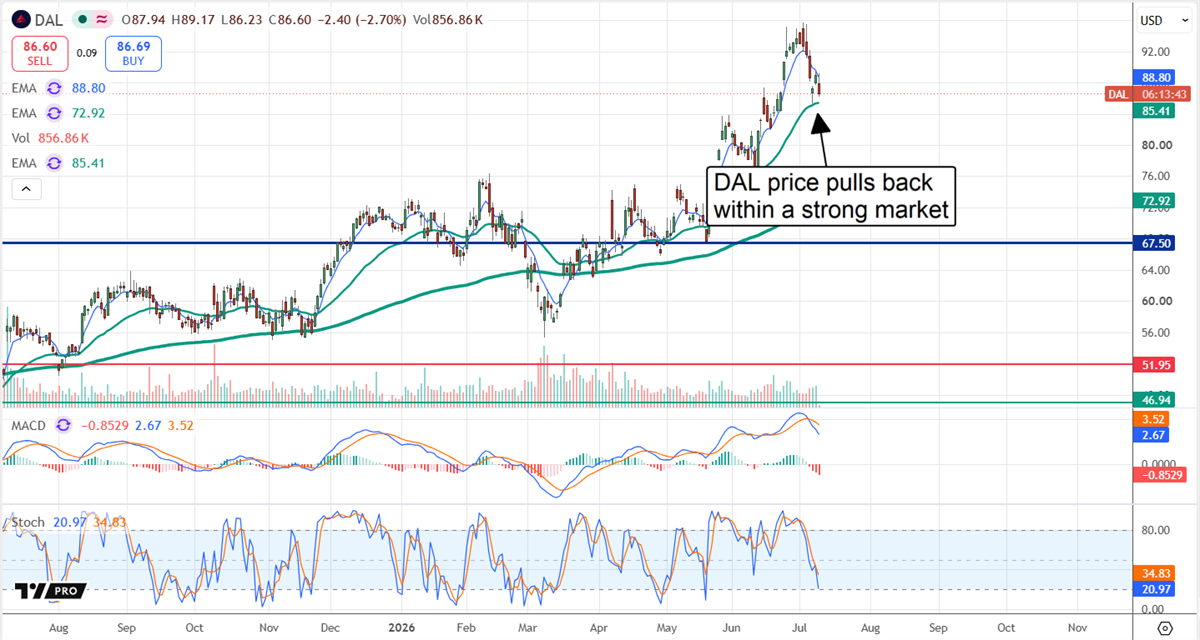
The stock price action is favorable, despite the early Q3 price pullback. Delta is rising on a wave of strength, cash flow, and dividends that has yet to play out, leaving the underlying uptrend intact. The likely outcome is that support kicks in at or near the early July lows, leading to a trend-following signal and price rebound later this year. Signals of strength include MACD convergence on the weekly chart, suggesting the latest highs will at least be retested, and support at the 30-day exponential moving average.
Further Reading
- 3 Rare-Earth ETFs That Help Investors Balance Exposure and Risk
- ALERT: Drop these 5 stocks before the market opens tomorrow! (From Weiss Ratings)
- Microsoft Bets on In-House AI to Cut OpenAI and Anthropic Costs
- Ray Dalio: Buy Gold. Get Paid. (From Investors Alley)
- This Dividend ETF Choice Could Shape Your Income Strategy Through 2026
- Why "Big Short" Investor Michael Burry Sees Upside in Beaten-Down Sportbook Stocks
- Starbucks Builds Sovereign AI to Cut $400 Million in Software Costs
Stay Ahead of the Market
The best investment opportunities don't wait. Get our research and stock ideas delivered straight to your smartphone—so you never miss a market-moving opportunity. Our text alerts ensure you see timely stock ideas and professional research reports instantly, whether you're in a meeting, commuting, or away from your desk.


