Trump just signed it (From Investors Alley)
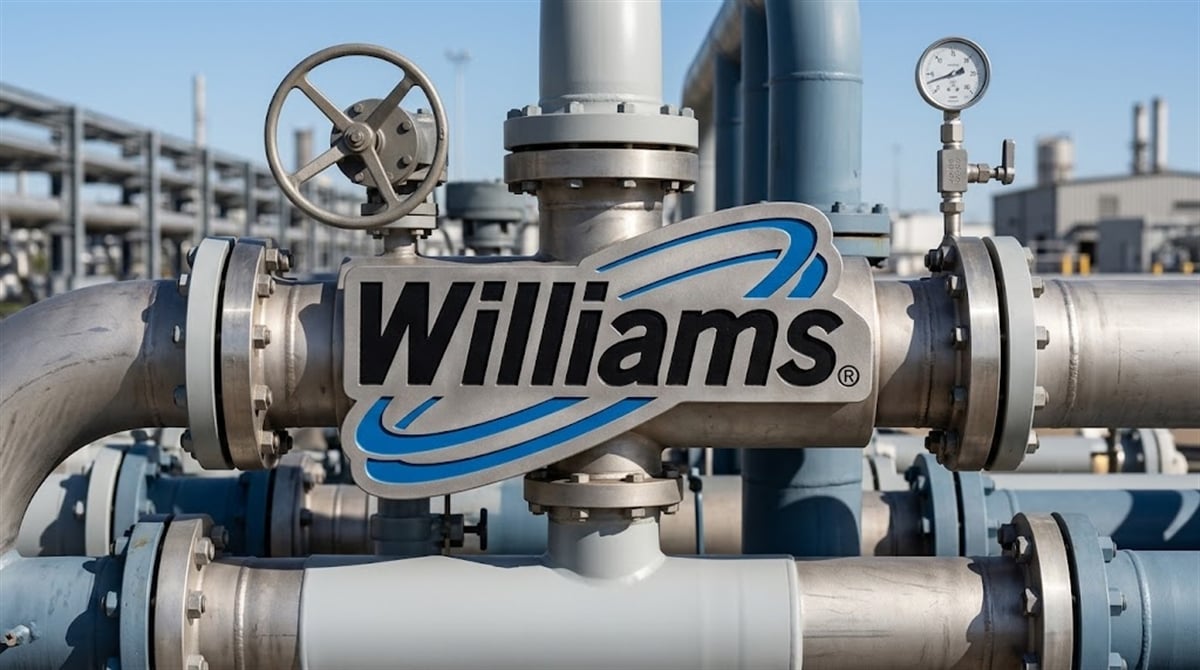
Key Points
- Williams Companies is leveraging AI data center demand to drive long-term natural gas growth and recurring revenue
- Record EBITDA and a $15.5B backlog highlight strong fundamentals despite a revenue miss in Q1
- Elevated CapEx and debt are manageable, with future projects expected to boost earnings and reduce leverage
- Special Report: NOT buy any SpaceX IPO shares until you read THIS (From Weiss Ratings)
Williams Company Inc. (NYSE: WMB) moved up a modest 1% after delivering mixed headline numbers in its Q1 2026 earnings report. The company delivered adjusted earnings per share (EPS) of 73 cents, easily beating expectations of 63 cents. However, revenue was a slight miss with Williams delivering $3.03 billion, below expectations of $3.28 billion.
Some context is required. For midstream infrastructure companies like Williams, revenue can be misleading due to commodity pass-through accounting. A more relevant metric of a company’s health is adjusted EBITDA. And that’s an area where Williams shone, reporting a record $2.25 billion.
The key takeaway from the report is that demand for natural gas far exceeds supply. The company cited research that natural gas demand will increase by 35% in the next decade. It’s a structural tailwind for WMB to move higher, even as it approaches its consensus price target and the top of its 52-week range.
The $7 stock Nvidia needs to finish the job (Ad)
Jensen Huang stood in Las Vegas and laid out Nvidia's vision for building the world's first trillion-dollar robot. But there's one thing Nvidia can't do alone.
A virtually unknown $7 company holds the technology Nvidia needs to make that vision a reality. Analyst Michael Robinson - who called Nvidia at $0.80 and Bitcoin at $300 - has identified this stock as his next potential winner, with nearly 20 prior calls returning 1,000% or more.
Click here to learn which $7 stock Nvidia needs right now
Williams Doesn’t Directly Export LNG, But...
Natural gas companies are getting a tailwind from the supply disruptions in the Middle East, which are increasing demand for LNG from the United States. That's not going to impact Williams directly, as its transmission pipelines are confined to the continental United States.
But the company does have an acquired interest in Louisiana LNG. That gives the company fixed-fee revenue tied to that export market. Also, the company’s Transco pipeline corridor is a primary gas artery for Gulf Coast LNG facilities. This is a specific, concrete relationship that positions Williams to benefit from expanding Gulf Coast export capacity.
Data Centers Hold the Key to Long-Term Demand
The data center opportunity may be the most underappreciated element of the Williams growth story. The company is investing approximately $9.6 billion in behind-the-meter power projects. That means it is essentially building turnkey natural gas power plants directly connected to hyperscaler data centers, bypassing the traditional grid entirely.
The portfolio includes six named projects: Socrates, Apollo, Aquila, Socrates the Younger, Neo, and Atlas, with in-service dates ranging from late 2026 through 2028. Combined ISO capacity across these projects exceeds 2,500 megawatts, under agreements ranging from 10 to 12.5 years. Williams also has approximately 6 gigawatts of additional projects in its backlog.
The strategic logic is straightforward. Hyperscalers need power that is fast to deploy, always on, and independent of grid constraints. Renewables cannot currently meet that standard without massive battery storage infrastructure that doesn't yet exist at scale.
Williams is positioning itself as the answer to that gap. Instead of simply moving gas, this means Williams is embedding itself directly into customer infrastructure under long-term contracts.
The company’s backlog of approximately $15.5 billion between 2027 and 2033 accounts for about 18 months of current revenue. That’s a good reason to believe there’s a higher floor for WMB.
But how high is the ceiling? WMB is butting up to its consensus price target of roughly $79. Analysts have been slow to update their ratings and price targets since the report. However, since the company’s Q4 earnings report, a handful of firms have raised their price targets. The most bullish comes from Morgan Stanley (NYSE: MS), which raised its target to $90 from $83.
These AI stocks could go to zero. Here's why. (Ad)
Louis Navellier - who manages $1.1 billion including $358 million in AI stocks - says a new AI computer being built at a classified government facility in Tennessee could make today's leading AI models obsolete overnight. He compares it to the iPhone moment that wiped out Nokia, BlackBerry, and Motorola.
When this machine comes online, it will reportedly accelerate AI breakthroughs 360-fold - compressing five years of progress into five days. Navellier has identified specific stocks he'd sell before this hits, and one ticker he'd buy before May 5th.
See the full free presentation with names to buy and sell now
How Concerned Should Investors Be About the Debt?
The one area of the report that investors shouldn’t be too quick to dismiss is the company’s growing capital expenditures (CapEx). The new midpoint of $7.3 billion has pushed the company’s leverage to approximately 4.1x. That’s only a tick above the company’s target of between 3.5 to 4x.
In a vacuum, the number isn’t a concern. Williams has an investment-grade balance sheet and laddered maturity levels. However, in 2008, WMB was rocked after a credit shock hit the market, catching the company offside. While a credit shock of that magnitude seems unlikely, the risk of a mild credit shock is not zero.
That said, there's probably an appropriate level of concern to apply to the company's elevated debt level. It’s not zero, but it’s not a high-priority concern.
The heavy capital investment is front-loaded into the current calendar year. And on the earnings call, the company noted that the projects coming online in 2027 and 2028 will generate new EBITDA, helping reduce the leverage ratio before active debt paydown begins.
Maybe Not a Stock to Hold Forever, But a Strong Performer for Now
The continued buildout of renewable energy projects, specifically solar and battery storage, is a real threat to Williams. However, the threat is likely not a significant one to the business until 2035 or later.
At that point, battery storage at grid scale will become economically competitive with natural gas. It's also when the company’s current wave of LNG export contracts begins to roll off. Adding to the bear case is that the timeline also roughly coincides with the company’s longer-dated transmission contracts coming up for renewal.
These three headwinds converging around the same horizon are worth monitoring. If any one of them accelerates faster than expected, that 2035 timeline could compress. But what may happen in the future isn’t the same thing as what’s happening right now. For now, Williams looks like a solid choice for income and growth during this unprecedented period of natural gas demand.
Read More
- Beyond NVIDIA: Picks-and-Shovels AI Plays with Strong Momentum
- Ticker Revealed: Pre-IPO Access to "Next Elon Musk" Company (From Banyan Hill Publishing)
- Quantum Earnings Season Is Ramping Up—What to Watch From 2 Major Players
- The #1 stock to buy BEFORE the June S-1 filing (From Behind the Markets)
- Flutter Sees Post-Earnings Boost as FanDuel Shows Signs of Recovery
- 3 Healthcare Stocks Set to Benefit From the One Big Beautiful Bill
- 3 Under-The-Radar Small Caps Making New All-Time Highs
Stay Ahead of the Market
The best investment opportunities don't wait. Get our research and stock ideas delivered straight to your smartphone—so you never miss a market-moving opportunity. Our text alerts ensure you see timely stock ideas and professional research reports instantly, whether you're in a meeting, commuting, or away from your desk.


