Sell 99% of Your Stocks, Do THIS Instead… (From The Oxford Club)

Key Points
- Energy has been the top-performing sector so far in 2026, riding the oil price spike to a massive gain of over 25% after years of underperformance.
- But now that a potential ceasefire between the United States and Iran has been reached, the upside in energy stocks appears to be fully priced in.
- Broadly, energy investments are starting to get overbought, and for the following two stocks, it might be time to take profits.
- Special Report: The 200-to-1 gold ratio that breaks on May 29th (From Behind the Markets)
A fragile ceasefire appears to have been reached between the U.S. and Iran, which pushed down oil prices and helped stocks gain more than 2% following the announcement. That trend has persisted, with the S&P 500 up by over 3% since ceasefire news broke on Tuesday, April 7.
The development highlights the ever-changing nature of geopolitical conflicts, but it also underscores the importance of taking profits on unexpected gains. Now that the energy sector is looking overbought, it might be time to take profits on some of 2026’s early winners.
Tiny “$3 AI Wonder Stock” Could Make You Richer (Ad)
A under-the-radar AI stock trading for just $3 could be one of the most overlooked opportunities in the market right now.
While Nvidia dominates headlines, this small-cap play is positioned for significant upside at a fraction of the price.
Discover our No. 1 AI pick before the broader market catches on.
Geopolitical and Technical Signals Indicate a Break in Energy's Rally
Energy has far and away been the best-performing sector in 2026. The Energy Select Sector SPDR ETF (NYSEARCA: XLE) is up nearly 30% year-to-date (YTD), which would have sent the entire S&P 500 soaring a few decades ago. But with the explosive growth of the Magnificent Seven and other mega-cap companies, the energy sector now accounts for less than 5% of the cap-weighted index. As a result, this year's market-leading performance hasn’t been enough to stem the tide of the index's decline.
However, now that a tenuous ceasefire has been reached, the energy sector is looking overbought and ready to lose some of the catalysts that propelled it earlier in 2026. In turn, some reasons investors might want to consider selling the sector due to a few challenges it will now face.
The first challenge is a fading geopolitical risk premium. Even before the ceasefire was reached, the energy rally was starting to get long in the tooth. According to futures markets, investors have bet that oil will be above $90 per barrel through December amid structurally higher fuel and petroleum prices. Much, though not all, of the extra profit going to the oil and gas industry has been priced in, and de-escalation with Iran charging tolls for passage through the Strait of Hormuz is actually a headwind.
Another headwind is potential demand destruction. Prices for West Texas Intermediate futures reached $115 before settling around $95 following the ceasefire announcement. While consumers obviously prefer $95 oil to $115 oil, this is still a major challenge for consumption, given that prices were under $60 to start the year. Sustained prices around $100 will compress the margins of airlines and transportation companies, and price spikes tend to take a few months to spill over into the broader economy. High prices won’t do energy stocks any good if consumers stop buying.
Lastly, the energy sector is showing oversold technical signals. After reaching 80 on the Relative Strength Index (RSI), the XLE plunged to below 50 in less than two weeks, indicating a massive drop in bullish momentum. Some large-cap energy stocks remain above the 70 overbought threshold, warranting consideration for sale.
If the price-shock component of the oil crisis is ending, it could trigger a sell-off of some overbought energy names. The following two companies have soared to new all-time highs, but now that the geopolitical tailwind is gone, fundamental and technical problems are increasingly evident.
Suncor Energy: Share Buybacks Mask Declining Revenue
Suncor Energy (NYSE: SU) is Canada’s largest integrated oil and gas company, but the recent surge in crude oil prices has hidden some of the firm’s underlying problems. Suncor missed revenue projections in its Q4 2025 earnings report, with revenue falling 3% year over year to $8.77 billion.
The company has repurchased more than 12% of its float during its current buyback program, which may have kept the share price artificially inflated before this price shock. The next earnings report is scheduled for May 5.
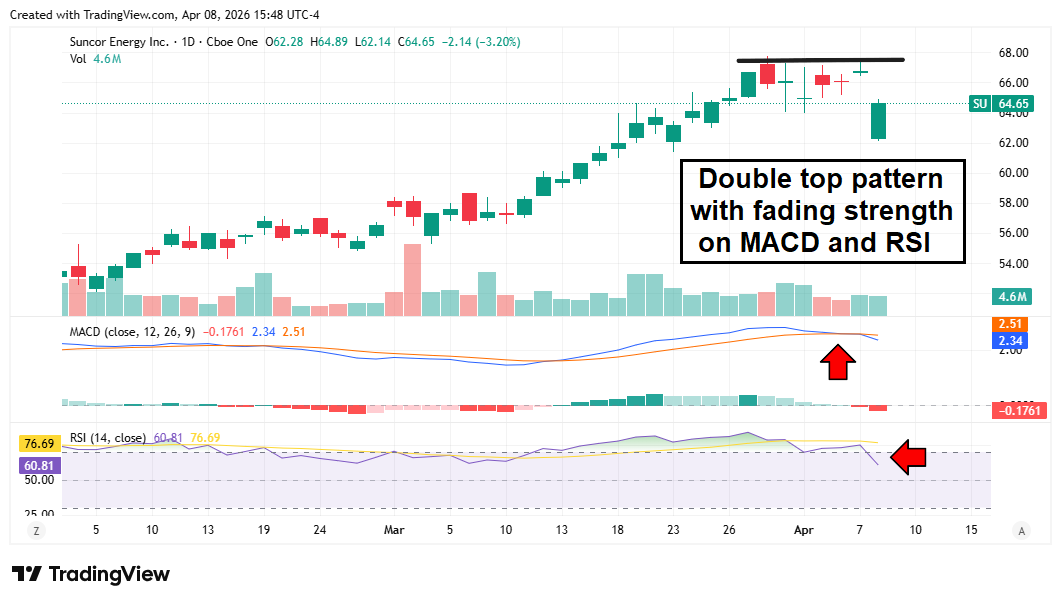
Technical headwinds abound on the daily chart as well, led by a double-top pattern that often precedes a pullback. The RSI has been in Overbought territory since the second week of March, but now the momentum is fading, and the indicator has pulled back to its lowest level in months. The Moving Average Convergence Divergence (MACD) also appears to confirm the momentum shift with a bearish crossover.
Altucher: This is My Favorite FREE Starlink Pre-IPO Ticker (Ad)
In the next 3 minutes…
James Altucher – legendary investor and venture capitalist…
And someone who’s known for playing his cards “close to the vest”…
Is going to give you the name and ticker symbol of a company he believes will skyrocket thanks to the coming Starlink IPO…
Click here to watch this short 3-minute video now.
Entergy: Bullish Catalysts Appear Fully Baked In
Entergy (NYSE: ETR) has ridden the energy surge despite belonging to the utility sector. But despite a roughly 25% YTD gain, the company’s catalysts are far from generating revenue or are already baked into ETR's stock price.
Entergy has an agreement with Meta Platforms (NASDAQ: META) to supply power and infrastructure to a massive Louisiana data center, but the deal has not yet boosted current earnings. In its Q4 2025 report, Entergy reported a slight miss on both earnings per share and revenue, while reaffirming its expectations for an 8% annual growth rate through 2029. While an 8% compound annual growth rate for a utility seems like a solid investment, ETR shares trade more like an energy stock with a price-to-earnings ratio near 29 and a price-to-sales ratio above 4.
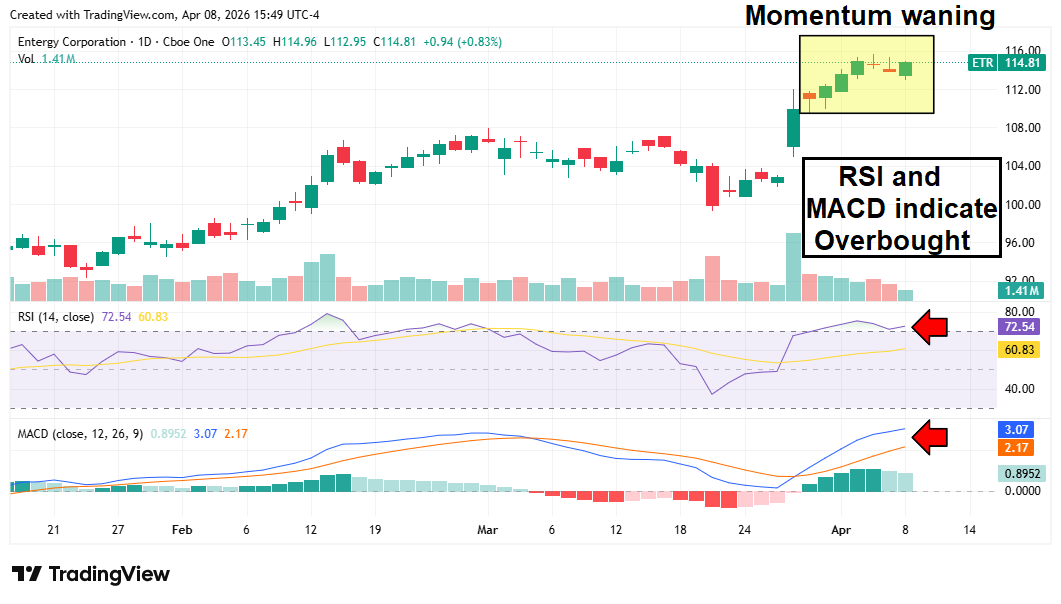
If the energy surge fades, so will the momentum in ETR shares. The technical chart also shows buying pressure easing after a massive late-March surge, which could signal profit-taking. The RSI remains in the Overbought range, and the MACD hints at increasing volatility, with the MACD and signal lines widening. If the bullish momentum dissipates, investors will begin questioning why they own a utility trading around 29 times forward earnings.
Read More
- 3 Under-the-Radar Tech Names Investors Might Have Missed
- Ticker Revealed: Pre-IPO Access to "Next Elon Musk" Company (From Banyan Hill Publishing)
- These 3 ETFs Are Suitable for Ultra-Bearish Investors
- AI CEO Issues Code Red: Prepare for Meltdown (From Paradigm Press)
- Space Race 2.0: AI's Trillion-Dollar Escape Plan
- MarketBeat Week in Review – 04/06 - 04/10
- Why Simply Good Foods Stock Just Had Its Worst Day in Years
Stay Ahead of the Market
The best investment opportunities don't wait. Get our research and stock ideas delivered straight to your smartphone—so you never miss a market-moving opportunity. Our text alerts ensure you see timely stock ideas and professional research reports instantly, whether you're in a meeting, commuting, or away from your desk.


