The Fed’s new digital cage for your savings (From Weiss Ratings)
Key Points
- The launch of the Ising open-source AI family positions NVIDIA as a foundational software provider for the rapidly maturing quantum computing ecosystem.
- Hardware specialists like IonQ and Rigetti Computing are poised to benefit from standardized software that automates complex system calibration tasks.
- Integrating sophisticated AI models into quantum workflows represents a major transition from theoretical research to practical enterprise applications.
- Special Report: This Elon-approved AI income stream could make you $30k-$50k a year (From InvestorPlace)
On April 14, 2026, what might have seemed like a niche software update from NVIDIA (NASDAQ: NVDA) created a tidal wave in the quantum computing sector. While the semiconductor sector titan’s stock price rose 3.73% to close at $196.38, the impact on pure-play quantum companies was far more profound. IonQ (NYSE: IONQ), a leader in trapped-ion quantum systems, saw its shares jump 20.19% to close at $35.77. In lockstep, Rigetti Computing (NASDAQ: RGTI) climbed 11.50% to close at $16.87.
Just $5 - AI Stock Is Turning Heads (Here’s Why) (Ad)
While attention stays fixed on dominant AI names, one low-priced stock is gaining quiet momentum - trading for pennies compared to industry leaders like Nvidia.
Early investors still have a window before this pick reaches wider awareness. A modest position could establish exposure ahead of broader attention. A 12-page Special Report covers the full case, including the name and ticker.
Watch the video update and get the name and ticker now
This synchronized rally is a textbook example of the NVIDIA halo effect. Investors have seen this pattern before, most notably in the AI data center space, where NVIDIA’s CUDA platform became the undisputed industry standard, lifting the entire ecosystem.
When the $4.77 trillion company plants its flag in a new technological territory, it serves as a powerful validation, signaling to the broader market that the sector is shifting from speculative science to a commercially viable enterprise. The market's decisive reaction suggests that NVIDIA's latest move is viewed as a fundamental catalyst poised to redefine the industry's future.
From Unruly to Reliable: A Look at the Ising AI Models
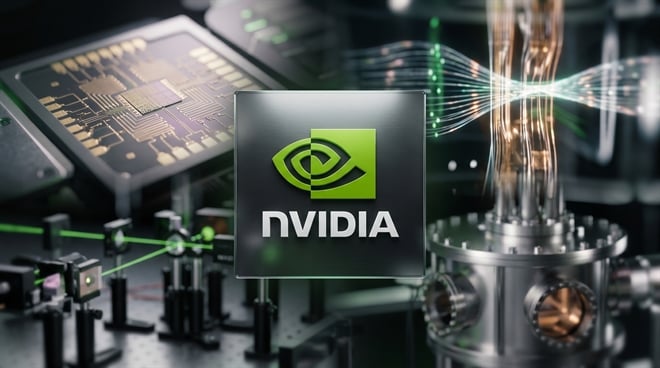
At the heart of this industry-wide re-rating is NVIDIA's Ising, the world's first open-source AI model family designed to manage quantum computers. To grasp its significance, investors must understand the monumental challenges that have historically constrained the development of quantum hardware.
Quantum bits, or qubits, are the building blocks of quantum computers, but they are incredibly fragile and prone to errors from the slightest environmental disturbance.
Furthermore, calibrating these complex systems is an arduous task.
Imagine trying to perfectly tune an orchestra of thousands of highly sensitive, temperamental instruments simultaneously; that is analogous to the challenge of preparing a quantum processor for a calculation.
NVIDIA's Ising models confront these two bottlenecks, error correction and calibration, by using AI as the master conductor.
Automating the Orchestra: The Ising Calibration model acts as an AI-powered tuning fork, automating the complex calibration process. It reduces a task that previously took days of painstaking work by highly trained physicists to a matter of hours, a massive leap in operational efficiency.
Building a Noise-Canceling Shield: The Ising Decoding models provide an intelligent system for real-time error correction. They are up to 2.5 times faster and 3 times more accurate than existing open-source methods, effectively creating a software shield that makes fragile qubits more robust and reliable.
By releasing these tools as open source, NVIDIA has laid the foundation for a standardized software layer across the entire quantum industry. This move allows hardware specialists to accelerate their development cycles and focus on innovation, knowing a powerful and reliable operating system is already in place.
Riding NVIDIA’s Coattails: A Tale of 2 Quantum Companies
With a new software standard emerging, the hardware companies that can best integrate these tools stand to gain a significant competitive advantage.
IonQ, with a market capitalization of $13 billion, is a clear frontrunner. The company received a major third-party endorsement when it was named in NVIDIA's official announcement as an early adopter of the Ising Calibration model. This software integration powerfully complements IonQ’s strategic focus on hardware scalability, underscored by its acquisition of semiconductor fab SkyWater Technology. This move gives them greater control over manufacturing, a crucial advantage that NVIDIA's efficiency-boosting software can now amplify. It is this combination of hardware strategy and software adoption that supports the Moderate Buy analyst consensus and bullish price targets.
Meanwhile, Rigetti Computing is another key beneficiary. The company has focused on achieving hardware milestones, such as delivering its 108-qubit system. The value of this powerful machine is now magnified by the existence of an off-the-shelf, world-class software suite to run it. This collaboration is critical for Rigetti as it works to leverage its stable base of government contracts to attract a wider array of commercial clients. For a company with a greater than $5 billion market cap, the NVIDIA catalyst provides a much clearer roadmap for translating its impressive technical achievements into mainstream enterprise adoption and revenue growth.
The Quantum Roadmap: From Theory to Tangible Opportunity
The launch of NVIDIA's Ising models marks a fundamental pivot in the quantum computing investment landscape. The narrative is no longer solely about a long-term race to build the biggest hardware; it is now also about a near-term opportunity to deploy enterprise solutions on a standardized software platform.
The convergence of NVIDIA's AI prowess with the dedicated hardware from innovators like IonQ and Rigetti signals the beginning of a new, more commercially-focused chapter for the industry. While investors should remain aware that the path to large-scale, fault-tolerant quantum computing is still a multi-year journey, this software catalyst has illuminated the way forward.
Investors tracking the sector should focus on which hardware firms successfully adopt and innovate on this new software layer. Their capacity to do so will probably signal their chances of leading in the upcoming software-driven quantum era.
Recommended Stories
- Why Oil Refiners Are the Real Winners of $100 Oil Prices
- Ticker Revealed: Pre-IPO Access to "Next Elon Musk" Company (From Banyan Hill Publishing)
- Apple's Foldable iPhone Foray: A Real Needle Mover or Hype Train?
- Altucher: This is My Favorite FREE Starlink Pre-IPO Ticker (From Paradigm Press)
- Sky-High Stakes: United and American Merger Rumors
- Are Oracle’s 30,000 Layoffs a Sign of Weakness or Strength?
- 95% Options Surge: Smart Money Bets Big on a Super Micro Bounce
Stay Ahead of the Market
The best investment opportunities don't wait. Get our research and stock ideas delivered straight to your smartphone—so you never miss a market-moving opportunity. Our text alerts ensure you see timely stock ideas and professional research reports instantly, whether you're in a meeting, commuting, or away from your desk.


