Think gas prices are bad? This is Much Worse (From American Hartford Gold)
Key Points
- The Russell 2000 is on track to hit new highs, and the ETFs that track it are following suit.
- Resilient economic conditions, lower interest rates, and an improved earnings outlook underpin the price outlooks for the IWM and VTWO.
- Institutions are buying those two funds, which are the leading Russell 2000-tracking ETFs for investors and traders.
- Special Report: This Elon-approved AI income stream could make you $30k-$50k a year (From InvestorPlace)
The Russell 2000 is a critically important index that tracks the leading 2,000 small-cap stocks on U.S.-listed markets. Arguably the riskiest stocks, those belonging to the Russell 2000 tend to perform best when economic conditions are at their prime. And right now, the index is on track to hit fresh highs.
The underlying driver is economic resilience, as reflected in the labor market figures, which continue to reflect growth. While job numbers have contracted from post-COVID peaks, labor conditions have normalized to healthy levels and are showing improvement relative to last year.
The most current available labor data is the weekly initial claims and total claims figures. As of early April, initial claims are trending near 200,000, deep in the healthy range, and total claims are receding. The total number of claims is not only contracting compared to the prior year, but the late March figures show the decline is accelerating, and there are reasons to believe that will continue.
The United States is heading into the spring hiring season with tailwinds forming. Macroeconomic concerns aside, the onshoring of critical supply chains, data center and energy demand, and consumer trends, coupled with deregulation and tax relief, underpin activity and may accelerate as the year progresses.
That's good news for two exchange-traded funds (ETFs) that track the small-cap index: the iShares Russell 2000 ETF (NYSEARCA: IWM) and the Vanguard Russell 2000 ETF (NASDAQ: VTWO).
Sell 99% of Your Stocks, Do THIS Instead… (Ad)
Millionaire Trader Exposes: "The Single Stock Income Plan"
With over 6,000 stocks on the market to choose from...
Millionaire trader Nate Bear IGNORES 99% of them...
Instead, he trades just one...
He calls it: "The Single Stock Income Plan".
And in a single month, while the S&P 500 handed investors a measly 0.05% return...
His readers had the chance to collect: 100% in the same day... 100% overnight... 100% in 3 days... and 114% in 3 days.
Four separate trades. One stock. And all could've DOUBLED your money.
That's the equivalent of collecting 40 YEARS of typical stock market gains... crammed into a single month.
Why These 2 Small-Cap ETFs Are Heading Toward Long-Term Highs
For ETF traders, that combination—small caps holding near record territory alongside still-stable labor signals—helps explain why Russell 2000-tracking funds like IWM and VTWO have been pushing higher as well.
Price action for these two ETFs is underpinned by the Russell 2000's outlook and by institutional inflows, which align with the idea of the market's ongoing rotation—when fundamental conditions shift, as they did when the Federal Reserve embarked on its rate-cutting agenda, for example, it is bullish for stocks.
In this case, the improving economic outlook is prompting institutions to broaden their holdings to a wider array of names as they trim profits in lagging, large-cap stocks such as NVIDIA (NASDAQ: NVDA).
The question for ETF investors and traders is which Russell 2000-tracking fund is best for them? The primary differences are the expense ratios and liquidity, which makes the choice easier.
The VTWO has a lower expense ratio (0.07% to 0.19%), making it cheaper to own for long-term investors, while IWM is more liquid (nearly 44 million in average daily volume compared to just 4.8 million). Liquidity is critical for short-term trades as it enables quick entries and exits with minimum slippage. IWM also has a robust options listing, which is ideal for short-term speculation and cash-flow generating strategies such as covered calls.
Russell 2000 Catalysts: The FOMC, Interest Rates, and Earnings Growth
A primary catalyst and risk for the Russell 2000 is the Fed's FOMC and its interest rate trajectory.
As it stands, lower rates are driving the small-cap rotation, but they may not linger for long. The risk is that higher oil prices triggered by the Iran war will accelerate inflation and lead the Fed into a hawkish stance. The best-case scenario as of early April is that the committee stands pat, allowing what many are calling the “Great Rotation” to continue: a major market shift out of overvalued, high-flying tech and into cheaper, more defensive corners of the market.
Earnings growth is another important catalyst for this index and the ETFs that track it. Russell 2000 earnings had been forecast to grow, but rate cuts have strengthened the outlook due to their impact on borrowing costs. Forecasts for Q1 suggest as much as 45% year-over-year (YOY) earnings growth, which may be a cautious estimate. Full-year forecasts are also likely to be cautious, expecting the YOY strength to subside as the year progresses.
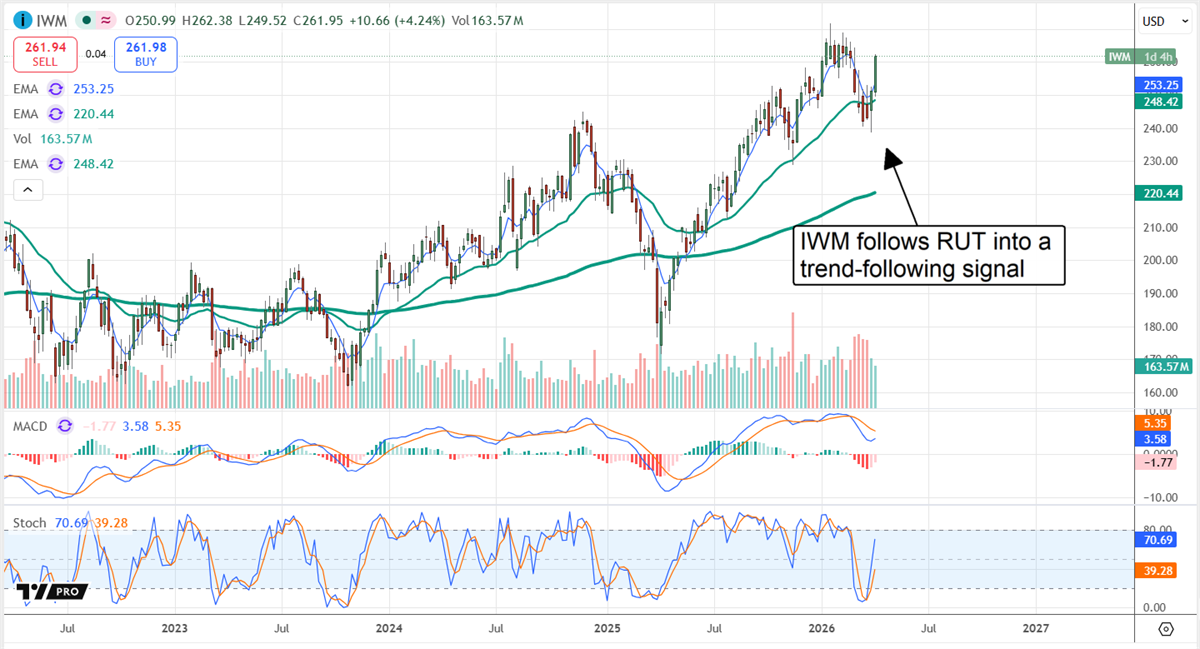
But price action as of early April is extremely bullish for this index and its most tightly correlated ETFs. The Iran war and AI disruption fears have caused the market to correct, but support was established at a critical level, aligning with prior highs, and a rebound is underway. Indicators such as the stochastic oscillator and MACD suggest a potentially significant momentum shift, suggesting the rebound may be robust and long-lasting.
The likely outcome is that the Russell 2000's all-time high will be tested before mid-year—and potentially before the end of May—and new highs will quickly follow. Technical factors suggest a move to 3,000 is the base case in this scenario, and higher highs are likely to follow.
Featured Stories
- With Nike Shares Near a 12-Year Low, Is Now the Time to Be Brave?
- Rickards: My #1 Gold Play For 2026 (From Paradigm Press)
- 3 Different Fintech Giants: Turnaround, Stability, or Risky Bet?
- Ticker Revealed: Pre-IPO Access to "Next Elon Musk" Company (From Banyan Hill Publishing)
- Microsoft’s Copilot Problem Isn’t What You Think
- 3 Surprising S&P 500 Outperformers of 2026
- It's Time to Take Profits on These 2 Overbought Energy Stocks
Stay Ahead of the Market
The best investment opportunities don't wait. Get our research and stock ideas delivered straight to your smartphone—so you never miss a market-moving opportunity. Our text alerts ensure you see timely stock ideas and professional research reports instantly, whether you're in a meeting, commuting, or away from your desk.


