Nvidia's Huang doubts Musk's latest mega plan can work (From Brownstone Research)

Key Points
- Whirlpool's Q3 results disappointed investors, but cost reductions and pricing actions contributed to sequential margin improvements.
- Whirlpool maintained its $300 million free cash flow outlook for 2026 and expects year-end net debt below $4.5 billion.
- High short interest could amplify a recovery rally, although weak demand, dilution, and financial pressures remain significant risks.
- Special Report: Nvidia pays a tiny dividend but this AI fund pays weekly (From Investors Alley)
Whirlpool’s (NYSE: WHR) stock sold off in a capitulatory move after the Q3 release, appearing to price in a terminal scenario in which sales keep slumping, margins implode, and the business fails. But the market could be getting it wrong.
While near-term headwinds persist, Whirlpool is in the midst of a cyclical downturn linked to frozen housing markets, not its core business. The likely outcome is that housing markets eventually recover, and when they do, WHR stock could quickly revert to its mean, underpinned by improving sales, margins, cash flow, and capital return capacity.
The market overlooks the ongoing turnaround, including structural cost savings, sequential margin improvements, and pricing actions expected to take hold this quarter. The setup has positioned the company to potentially improve margins in Q4 and meet its full-year free cash flow targets, which is significant because it still forecasts positive full-year free cash flow despite declining sales and reported losses.
Free cash flow is central to the company's balance sheet improvement plans. Among the Q3 highlights is an improved outlook for debt reduction, with the company targeting net debt of less than $4.5 billion, down from $5 billion previously. The company also refinanced some debt, increasing near-term interest obligations but extending its maturity ladder and creating a more favorable path to balance sheet improvements until housing markets improve. When that happens is anybody’s guess, but likely tied to interest rates.
A weekly dividend fund holding Nvidia and Palantir (Ad)
CrowdStrike, Palantir, Nvidia none of them pay a real dividend. But one fund holding the biggest AI names distributes income every single Thursday, with payouts reported as high as $1,051 a month.
Chief Income Strategist Tim Plaehn breaks down the fund's real Thursday distribution history, how the income is generated, and how to buy it in any brokerage account.
Watch the free presentation before this Thursday's payout
Whirlpool Whiffs in Q3, Lower’s Guidance, Market Gives Up Hope
Whirlpool struggled in Q3, with revenue contracting 8.8% to $3.68 billion, a quarter billion below consensus. Weakness came from a 5.4% organic decline and divestitures, while higher costs also pressured margins. Regionally, the core MDA North America segment was weakest, contracting by 8.3%, followed by a 0.7% contraction in SDA Global, offset by a 6.9% increase in MDA Latin America. Latin American strength is critical, as it represents one of the strongest emerging markets, with business underpinned by industrialization and a rapidly growing middle class.
Margin news is ugly, with GAAP and adjusted losses posted and worse than expected, but sequential improvements were seen and are expected to continue in the upcoming quarter despite the guidance reduction. More importantly, most of the losses are non-cash, so they're not as bad as they seem, though still not good.
Guidance is a factor in the stock price decline, with revenue and earnings weaker than expected, but the cash flow outlook offers a silver lining. The company expects to generate $700 million in cash from operations and $300 million in free cash flow for the full year, despite negative free cash flow of $1.08 billion through September, enabling it to potentially sustain balance sheet improvement trends and set itself up for a better 2027.
Analysts and Short-Sellers Create Downdraft in 2026
Analysts and short-sellers are weighing heavily on WHR's price action in late 2026 and will likely keep it under pressure for the foreseeable future.
While analysts have been reducing targets and ratings, dropping the consensus to a Reduce and the price target to $35.67, short-sellers have increased their positions.
The 28% short interest reflects substantial bearish positioning, given the absence of strong near-term bullish catalysts, and may increase before it improves.
The upshot is that high short interest fuels the potential for a snap-back, needing only a catalyst to emerge to invigorate covering and a short squeeze.
The days-to-cover figure is also relatively high, at just over 5.7, suggesting that short covering could amplify a rally when the catalyst emerges.
Your Free Options Trading Guide May Not Stay Free (Ad)
A free copy of Options Trading Made Simple is available now but wont stay that way for long.
Chris Rowe calls it The 10-Minute Guide to Start Trading Options Today, built to help you open your first options trade with less capital than buying shares outright.
Download your free copy of Options Trading Made Simple before it's gone
Institutions Reflect Confidence in WHR: Upside Potential Swells
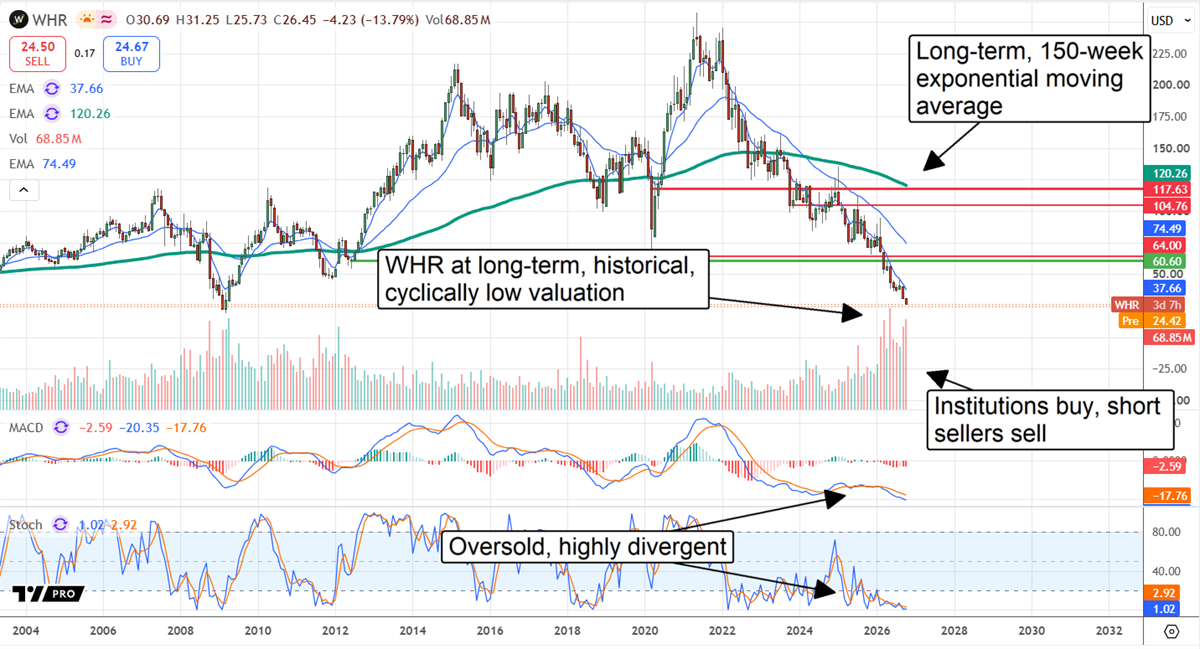
Institutional activity offers a bullish signal to investors. The group owns approximately 90% of the stock, reflecting confidence in the cyclical turnaround, and they’ve been buying in 2026. MarketBeat data reveals a $2.6-to-$1 trailing-12-month balance, with sellers nearly absent in Q3 and buying spiking to a multi-quarter high as price action reaches 17-year lows. With this in play, WHR stock can keep drifting lower, but the lower it gets, the bigger the snap-back if a recovery takes hold.
Dilution is one of the biggest risks heading into 2027. The company is on track to sustain operations and pursue improvements until the housing recovery begins, potentially in 2028, but may need to raise cash before then. As it stands, share sales helped improve the cash, debt, and equity position, but diluted value by nearly 16%, but don’t read too much into it. Share sales are a near-term risk that could eventually be offset by renewed buybacks if financial conditions improve. In this scenario, resumed buyback activity and reinstatement of the company's suspended common-stock dividend could strengthen the catalyst and upside potential.
Technically, a reversion to the mean means the stock price bounces back to its long-term 150-week exponential moving average, which could represent substantial upside from late-October levels. However, that moving average is not a guaranteed price target. A move to the high-end range, the opposite extreme, would represent even greater potential upside, though such a recovery would depend on significant improvements in Whirlpool's financial performance and the broader housing market.
Read More
- Starbucks Says Its Turnaround Is Done—The Numbers Make a Strong Case (With 1 Catch)
- How monthly income funds are tracking the IPO boom (From Investors Alley)
- 3 Robotics ETFs, 3 Different Ways to Bet on Humanoid Robots
- The chip inside every Tesla (From Behind the Markets)
- Can Microsoft Turn a Leaner Workforce and Record AI Spending Into Bigger Profits?
- Why JFrog Could Be the Software Infrastructure Company to Beat in the AI Boom
- The Factories Behind AI Servers Just Raised Their Outlooks—3 Contract Manufacturers to Watch

Stay Ahead of the Market
The best investment opportunities don't wait. Get our research and stock ideas delivered straight to your smartphone—so you never miss a market-moving opportunity. Our text alerts ensure you see timely stock ideas and professional research reports instantly, whether you're in a meeting, commuting, or away from your desk.


